
Supporting Water First: Clean Water for Indigenous Communities
For nearly three decades, Algonquin Tea Company has been blessed to harvest and grow our…
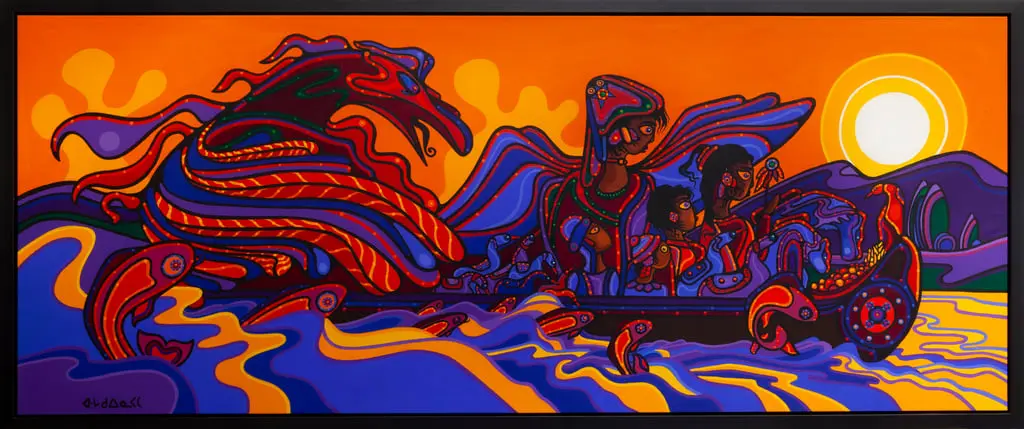
When people recognise Algonquin Tea Company on a shelf, they often notice the artwork first. The luminous animals, radiant spirits and flowing lines feel less like “packaging” and more like a doorway into another way of seeing the land. Those images were created by my dear friend, Canadian painter Ritchie Sinclair (Stardreamer), and they carry something I never could have conjured through branding alone. They carry spirit.
Ritchie’s incredible artwork is available at Mayberry Fine Art:
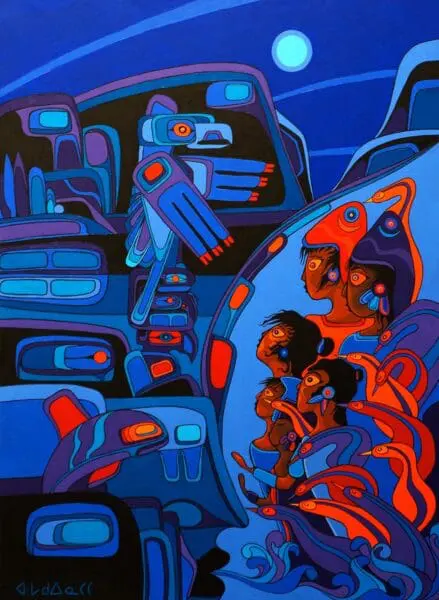
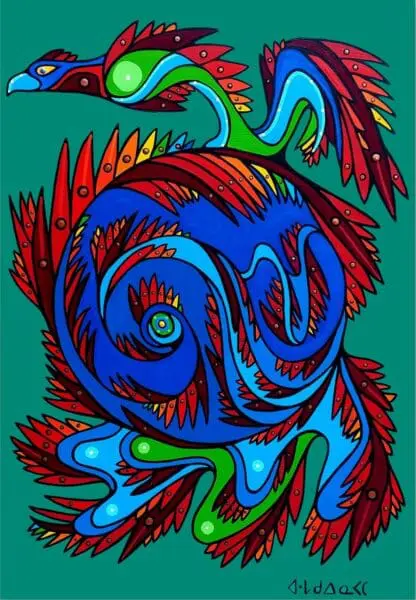

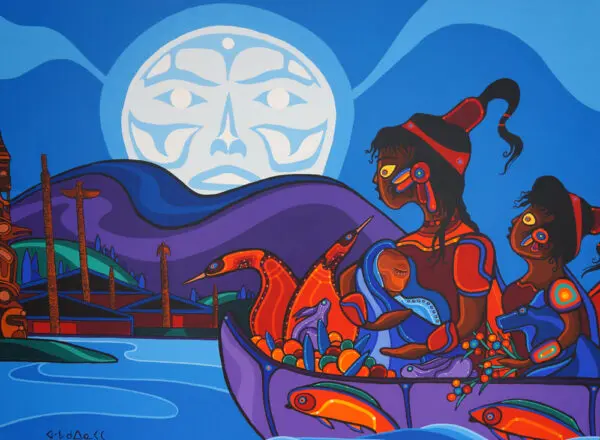
Ritchie was born in 1957 in Thunder Bay, Ontario, and grew up with both art and wild places as constant companions. As a child he painted, built and decorated kites, and spent time on solo canoe trips in places like Algonquin Park. When I first learned this about him, it didn’t surprise me at all. You can feel that wilderness in his work: the same spaciousness, the same sense that something alive and watchful is present just beyond the frame.
In his teens and early twenties he followed his creative calling through alternative arts education in Toronto, then into commercial art studies. But the turning point in his life came in 1979, when he met Ojibwe master artist Norval Morrisseau, the founder of the Woodland School of Art.
Morrisseau recognised something in Ritchie and took him on as an apprentice. He gave him the name “Stardreamer” and introduced him to Indigenous imagery and spiritual teachings that transformed how Ritchie understood painting: as a direct approach to Spirit and a way to contribute to the wellbeing of the world. That apprenticeship and friendship lasted nearly 18 years, and you can feel the depth of that formation in every piece he creates.
Norval Morrisseau with Ritchie Sinclair
At the National Gallery opening – 2006

Under Morrisseau’s mentorship, Ritchie developed a style rooted in Woodland visual language, with its bold lines, radiant forms, and interwoven human, animal, and spirit beings, yet unmistakably his own. His paintings are known for their sensually rich archetypes and brilliant colour, exploring themes of love, unity, and renewal: themes that resonate deeply with everything Steven Martyn and I were trying to grow with our teas.
Over the decades, Ritchie has exhibited widely, from early solo shows like Celestial Symbolism in Toronto in the 1980s to major public works such as the monumental painting Meeting Place, chosen as a centrepiece for the First International Pow Wow at Toronto’s SkyDome in 1994. His anti-Apartheid work Lighthouse, A Beacon of Hope in a Time of Despair toured with Archbishop Desmond Tutu’s visit to Toronto, a reminder that for Ritchie, art has never been decoration. It has always been a form of participation in the healing of the world.
In 2007, the McMichael Canadian Collection invited him to serve as Artist in Residence and guest lecturer, an acknowledgement of his role in the broader story of contemporary Indigenous-influenced Canadian art. Alongside painting, he has spent many years working with young people in schools and community settings, using co-creative art projects to help them experience their own creativity and connection to Spirit. That generosity is so characteristic of him.
Ritchie often describes himself as walking between worlds. Of Scottish lineage yet apprenticed in an Indigenous spiritual art form, he writes that his work is a “hybrid, embracing the strengths of each culture in order to create works which give insight into the qualities of both.” I recognise that bridge-walking. In many ways, it mirrors what we try to do at Algonquin Tea: honouring the knowledge of the original peoples of this land while sharing these plants with a much wider world.
That bridging role has also led him to protect the integrity of the Woodland tradition. Drawing on his deep knowledge of Norval Morrisseau’s oeuvre, Ritchie has become a respected voice in authenticating Morrisseau’s work and exposing large-scale forgeries, helping safeguard both collectors and the legacy of his teacher. It is the act of someone who understands that a tradition is a living thing, and that it is worth protecting.
Without giving away all the fire teachings, as they say, there’s something important about how vision quests that many don’t realize. When you ask for a spirit animal, they come with a plant in the image and an element. They arrive together: a complete medicine bundle.
When we went to harvest our first sweet gale officially for what became Lucid Dream tea, we were blessed with a powerful confirmation. Ten loons escorted us up and down the river, diving under our canoe. Loons and water come with sweet gale. It was the land saying yes, showing us we were in right relationship with what we were doing.
This is why Ritchie’s artwork resonates so deeply with our teas. He understands these connections, how the visible and invisible worlds speak to each other through symbol and presence.

[Kim depicted on Homestead Blend artwork]
It’s this combination of lifelong relationship with wild places, spiritual apprenticeship, and a dedication to creating beauty that serves the world that makes Ritchie such a natural part of what we have built here.
Ritchie and I have been close friends for many years, long before Algonquin Tea found its way onto the shelves of Canadian natural food shops. I met painter and herbalist Steven Martyn when he was exhibiting at the Omega Centre that I managed in Yorkville. When Steven and I were searching for artwork that could carry the spirit of our wildcrafted teas, there was really only one person I could imagine turning to. Although Steven is also an artist, in his generosity he agreed that Stardreamer’s work would be the perfect pairing for our boxes. Someone who understood the land. Someone who understood that what we were doing was not simply a business but a kind of offering.

Ritchie created the powerful images that now appear across our packaging: guardians, animals, and spirit beings that feel less like logos and more like living presences. His own child appears in the Sacred Blend artwork, a beautiful reminder that this work has always been about family, connection, and passing wisdom between generations. I have always felt that the artwork does for the eyes what the tea does for the body: it opens something. It reminds you, even before the kettle has boiled, that you are in relationship with something larger than yourself.
In his own words, Ritchie describes the company this way:
“The Algonquin Tea Company is beyond ethical. Sacred intuition in action. 20 years and counting. Experience harmony wildcrafted: there is no substitute. I’m so thankful to Kim Elkington and Steven Martyn for their brilliance, dedication, staying power and the gift they have given so many.“
Reading that still moves me. Because the gratitude flows both ways. Ritchie’s images have given Algonquin Tea something that no amount of marketing could manufacture: an authentic visual soul. For both of us, this has always been a kindred project, an example of how business, land-based knowledge, and spiritual intent can quietly and stubbornly work together.
When you pick up a box or tin of Algonquin Tea, I hope you feel it: the life’s work of an artist who has spent decades exploring how colour, line, and symbol can express love for the Earth and for all beings who share it.
Ritchie’s images are part of a much larger story, of Thunder Bay skies and solitary canoe journeys, of teachings passed from one generation to the next, of friendships built through shared ceremony, harvest, and creative work. They remind us that even a simple daily ritual like brewing tea can be a meeting place between spirit and land, artist and drinker, plant and person.
That is what I have always believed this company is for. And it is what Ritchie’s art has always known, long before I found the words for it.
